
The Italian Enigma
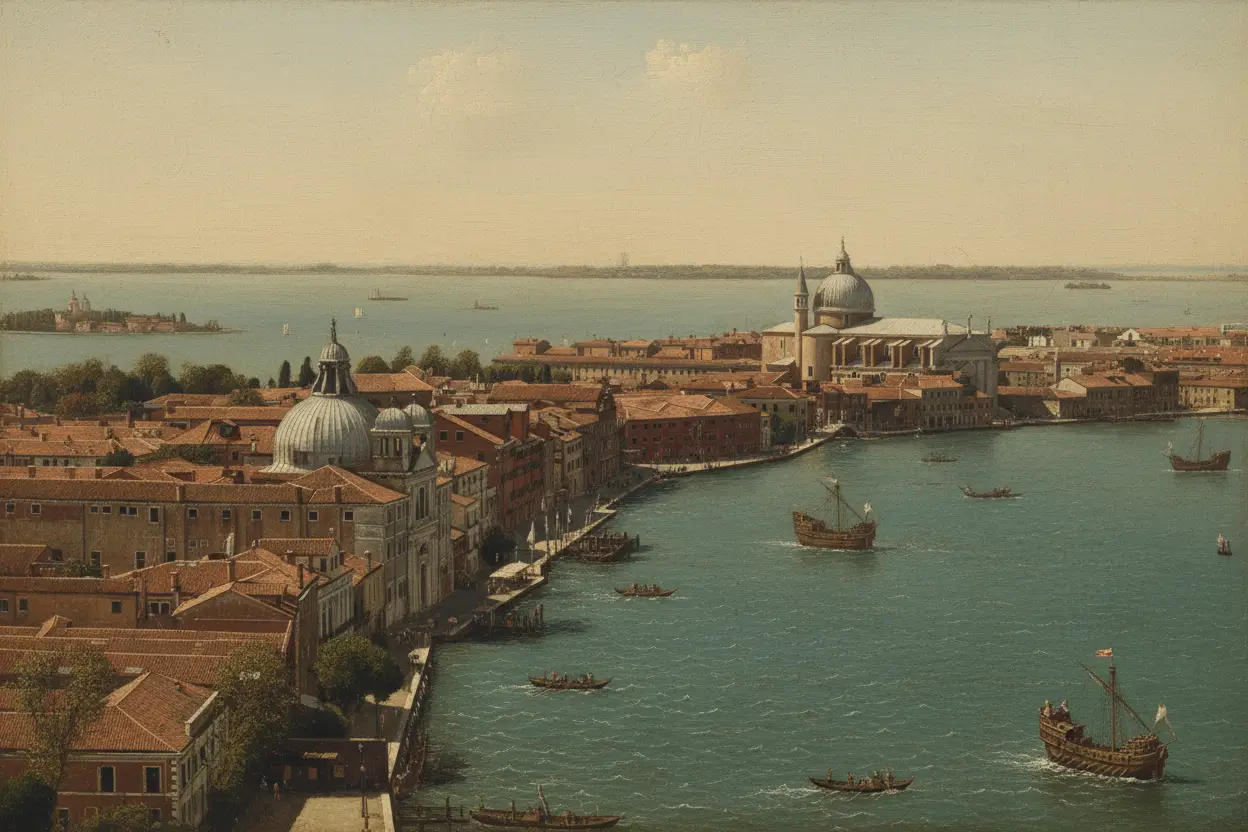
Over a third of Shakespeare’s plays are set wholly or partially in Italy. They are not just generic backdrops; they are filled with specific local details, accurate geography, and cultural nuances that were not available in English books or traveler’s tales at the time. The settings feel lived-in, not researched. This presents a major problem for the traditional story and points toward a deeper mystery.
How could William Shakespeare of Stratford, who never left England, write with such intimate, firsthand knowledge of Italian cities, customs, and laws? This question has puzzled scholars for centuries.
Venice: Beyond the Postcard
Let’s land in The Merchant of Venice. Shakespeare doesn’t just use Venice as a exotic name; he captures its very essence as a mercantile republic.
The play is saturated with the language of trade, risk, and contracts—the lifeblood of 16th-century Venice. Key locations like the Rialto bridge are not merely mentioned as landmarks, but are correctly portrayed as the city’s bustling commercial heart, where merchants like Antonio would have gathered for business.
“What news on the Rialto?”
Shylock, The Merchant of Venice, Act III, Scene I
This repeated line isn’t just filler; it’s an authentic detail. The Rialto was the Wall Street of its day. More strikingly, the play demonstrates knowledge of the unique, multicultural tolerance of Venice, where a Jewish moneylender like Shylock could operate openly, yet still face the underlying prejudices of the Christian majority. This complex social texture was not common knowledge in insular, Protestant England.
The Law of the Land
The legal climax of the play is its most telling detail. The trial scene showcases a sophisticated understanding of Venetian law, which was unique and distinct from English Common Law.
Portia’s argument against Shylock is built on a legal technicality about the shedding of blood—a concept rooted in Venetian statute. Furthermore, the conflict between Shylock’s demand for the “letter of the law” and Portia’s appeal for “mercy” mirrors the real-life legal tension between strict justice (strictum jus) and equity (aequitas) that was a hot topic in advanced legal circles, not a commonplace idea.
This isn’t the knowledge a playwright picks up from a story; it’s the insight of someone familiar with comparative law and high-level legal philosophy.
New to the Authorship Question?
Understand the foundation of our investigation with The Group Theory.
A Nobleman’s Grand Tour
So, who in the proposed “writers’ room” had this intimate, firsthand knowledge of Italy?
The historical record provides a perfect fit: Edward de Vere, the 17th Earl of Oxford.
In 1575, at the age of 25, de Vere embarked on a Grand Tour of Europe. We know from his letters and financial records that he traveled extensively through Italy for over a year. His itinerary reads like a checklist of Shakespearean settings: he visited Venice, Padua, Genoa, Milan, Palermo, and Florence.
He wasn’t a tourist. He was an aristocrat immersed in the culture. He spent lavishly, was presented with a patent of nobility by the Doge of Venice, and experienced the art, politics, and social customs of the Italian city-states firsthand. This direct exposure is the most logical explanation for the plays’ authentic Italian texture.
The Group Theory Verdict
The Italian problem is a cornerstone of the authorship question. The man from Stratford had no documented means of acquiring such nuanced, local knowledge. The plays, however, are demonstrably filled with it.
The Group Theory resolves this contradiction elegantly. It proposes that Edward de Vere provided the intimate, firsthand Italian details and courtly sensibilities. His travels and experiences became the raw material for the settings of The Merchant of Venice, Othello, The Two Gentlemen of Verona, and Romeo and Juliet.
He did not necessarily work alone. The legal precision in The Merchant of Venice could also point to the hand of Sir Francis Bacon, the group’s legal expert, polishing the courtroom drama. This collaboration between a traveled aristocrat and a legal philosopher creates a far more plausible authorship model for these complex, location-specific plays.
Join the Investigation
The evidence is on the page, and the historical footprints are there to follow.
What is your verdict?
- Can the authentic Italian details be explained by genius-level imagination alone?
- Does Edward de Vere’s documented travel make him the most likely source for this knowledge?
- Which other play contains a specific local detail that strikes you as impossibly accurate?